


Skillsoft
Skillsoft is a global leader in corporate learning, providing digital training and education solutions to help businesses improve workforce productivity, reduce risk, and increase innovation.

.webp)
.webp)
Here is the short answer, before the detail. Frontline training in India fails for a boringly practical reason: the platform assumes a worker who does not exist. It assumes a company email address, a laptop, a stable connection, a free hour, and comfortable English reading. The operator in Pune, the associate in Coimbatore, and the picker in Bhiwandi have none of those. The training is not rejected — it is never reached, and the flat completion report two quarters later gets read as a motivation problem when it was always an access problem.
That gap is why an eLearning platform for frontline workers India enterprises can actually deploy is a different category of product from the corporate LMS your head office runs — not the same system with a mobile app bolted on. This guide covers what changes, which platforms to shortlist in 2026, and how factory, retail, and logistics requirements diverge, because the vendor who is excellent for a 400-store chain is often wrong for a three-plant manufacturer.
A frontline learning platform is a mobile-first training system designed for deskless employees. Four things separate it from a standard corporate LMS:
Access model. Login by phone number, employee ID, or QR code — not a company email address most frontline workers were never issued. Content format. Microlearning under ten minutes, not sixty-minute SCORM courses. Language layer. Hindi plus regional languages in the content itself, not only the navigation menu. Delivery conditions. Offline playback and sync on entry-level Android, plus shared-device or supervisor-led modes for sites where personal phones are restricted.
The stakes are operational, not academic. Frontline roles are where execution risk lands first: a plant misses throughput when operators are undertrained, a network misses service commitments when drivers churn, and a store's conversion drops when associates cannot explain the product. Our industry-specific solutions hub covers how these requirements differ sector by sector.
Read the last two numbers together and the design brief writes itself: if the median frontline worker is gone inside two years and most are not on your payroll, a system built on slow annual cycles and HRIS-only enrolment is structurally mismatched to the workforce it serves.
It fails at the first screen. Before a course is opened, a desk-era system asks for a company email address — a credential most frontline workers in India were never issued. What follows is a chain of assumptions, individually reasonable and collectively fatal: that the learner owns a known device, that connectivity is stable, that forty-five uninterrupted minutes exist in the shift, and that English reading is sufficient to pass an assessment.
None of these hold. Because the failure is silent — no ticket, just a flat adoption curve — it gets misdiagnosed as a culture problem. It is a product-fit problem, and it looks different in each of the three sectors that dominate India's deskless workforce.
Phones are often restricted or prohibited on the production floor for safety and IP reasons. Training competes with takt time. Content must map to SOPs, safety protocols, quality checks, and machine-specific procedures that change with every new line.
Breaks on: no-phone policies, shift rosters, English-only SOPsHigh churn, seasonal surges, and constant product and promotion changes. Learning has to happen in five-minute gaps between customers, on a personal Android phone, and be current with this week's offer — not last quarter's catalogue.
Breaks on: churn, content staleness, no personal device policyWorkers are mobile by definition, frequently on contract, and often in low-connectivity zones. Training on handling, safety, route protocol, and customer interaction must survive an offline hour and sync later without losing the record.
Breaks on: connectivity, contract workforce, HRIS blind spotsThe most expensive misunderstanding in this market is treating interface language as content language. A platform can switch its menus to Hindi while every course, quiz, and certificate underneath stays in English — silently converting a knowledge test into a reading test. We unpack the distinction in our analysis of multilingual LMS options in India, and it is worth reading before any vendor demo.
Most shortlists start from general-purpose LMS roundups — our own roundup of the top 10 learning management systems in India included. Reasonable starting point, wrong finishing point: a platform can rank highly for corporate L&D and still be structurally unable to reach a warehouse night shift.
Ask any vendor to enrol and train one worker who has no company email, on a ₹8,000 Android phone, in Tamil, with the aeroplane mode switched on for the last three minutes of the module. If the completion record survives that, the platform is real. If the demo quietly moves to a laptop, you have your answer.
Most vendor sheets compare features. The useful comparison is between the conditions the two workforces learn under, because those conditions decide which features are load-bearing and which are decoration.
| Condition | Desk workforce (corporate LMS) | Frontline workforce (factory, retail, logistics) |
|---|---|---|
| Identity | Company email address, SSO, HRIS record from day one | Often no company email; large contract and temp population outside the HRIS |
| Device | Company laptop, dual monitor, occasional phone | Personal entry-level Android, shared kiosk, or a supervisor's phone in a group huddle |
| Connectivity | Office Wi-Fi, reliable and metered generously | Patchy mobile data; warehouse interiors, plant basements, and rural routes drop entirely |
| Time available | Calendar-blockable; 45–60 minute sessions are normal | Fragments between tasks; anything over 10 minutes competes directly with output targets |
| Language | English content is broadly workable | Hindi plus regional languages needed in the content, not just the menu |
| Schedule | Predictable working hours, single shift | Rotating shifts, night shifts, seasonal surge staffing |
| Tenure | Multi-year; slow annual learning cycles work | Median ~21 months, often far less; onboarding is the main event, not an afterthought |
| Definition of done | Course completed, certificate issued | Task performed correctly, unsupervised, on the floor — completion is a proxy at best |
| Failure cost | Slower ramp, missed development goal | Safety incident, product recall, damaged consignment, lost customer at the counter |
Vendors will tell you they are mobile-first, and most mean it. Far fewer handle the shop floor where personal phones are not permitted — common in pharma, electronics assembly, and any facility with IP or contamination controls. There, a beautiful personal-device app is worth nothing.
Two patterns work: a kiosk or tablet station near the line with employee-ID or QR login and no persistent session, and a supervisor-led group mode where one device drives a ten-minute huddle for a team of twelve. Most Indian manufacturers run both. Ask about them explicitly — they are rarely on the feature grid and almost never in the demo.
Per-active-user pricing sounds sensible until you meet a workforce with 21-month median tenure and seasonal surges. A chain that doubles headcount for the festive quarter can face a licence spike exactly when margins are thinnest. Ask how the vendor prices churn, contract staff, and seasonal peaks — and get it in writing before the security review.
Vendor grids for this category run to eighty rows. Ten decide whether the rollout works. Score every shortlisted eLearning platform for frontline workers against these, and treat the first four as gates rather than scores.
Phone number, employee ID, or QR enrolment. If a company email is required, most of your frontline cannot be onboarded. This is the single most common rollout blocker in India — and it is invisible until go-live week.
Five-to-ten-minute modules, single-objective, resumable. Ask to see the authoring flow, not a finished course: if building a short module means stripping down a sixty-minute SCORM package, it is a desk LMS in costume.
Content downloads, plays without signal, and syncs the completion record later without duplicating or dropping it. Non-negotiable for warehouse interiors, plant basements, and rural routes.
Hindi plus the languages your sites run on — commonly Tamil, Telugu, Kannada, Marathi, Bengali, Malayalam. Confirm whether translation covers the course, the assessment, and the certificate, or only the navigation.
A group huddle mode plus kiosk login for no-phone floors. Without these, any site with a device restriction is excluded from the programme entirely.
Assignments and nudges that respect rotating and night rosters. A 10am push is an interruption for someone who came off shift at 6am — and a reliable way to train people to ignore you.
Bulk upload, vendor-managed enrolment, or approval-based self-registration, so the extended workforce is not structurally excluded by HRIS-only sync.
Push a two-minute update the morning a line changeover happens or a promotion goes live — and convert existing SOPs into modules without a six-week design cycle.
A record of what each worker is certified to do, mapped to role and station, so supervisors staff from verified competence. This is the line between a course catalogue and a capability system — see our comparison of LMS vs LXP vs skills platforms.
Timestamped records with content version, language of completion, and score — because safety, POSH, and statutory training get examined after an incident, not before. Our piece on compliance training in the AI era covers what that now requires.
Score each vendor 0, 1, or 2 on all ten — 0 absent, 1 roadmap or workaround, 2 shipped and demonstrable on a real device. A zero on any of the first four removes the vendor regardless of total. A platform scoring 18 of 20 that cannot enrol a worker without an email address still fails on day one.
The market for an eLearning platform for frontline workers splits three ways: India-first platforms built for vernacular delivery and blue-collar realities, global frontline specialists with deep retail pedigree, and general-purpose LMS vendors that bolted on a mobile layer. All three can work — choosing across groups without knowing which one you are in is where procurement goes wrong.
India-first skills platform with mobile-first frontline delivery
Best forIndian enterprises of 200 to 50,000+ running a mixed workforce — head office on desktop, frontline on Android — across plants, stores, or hubs. StrengthsOffline-capable mobile delivery; localisation across Hindi, Tamil, Telugu, Kannada, Marathi, Bengali, Malayalam; native Darwinbox, Keka, Zoho People and greytHR connectors; skill-matrix mapping rather than completion-only reporting; SOP-to-microlearning conversion. Watch-outsThe core library is authored in English; genuinely vernacular-only workforces need content translation scoped as a project, not assumed as a switch.Mobile-first skilling suite with deskless credentials in retail, telecom, logistics
Best forLarge distributed frontline populations where sales capability and skilling sit together. StrengthsPurpose-built for deskless scale in India; established enterprise deployments; learning plus skilling analytics. Watch-outsEnterprise-weighted pricing and implementation; mid-market teams can find the configuration surface larger than they need.The global frontline enablement benchmark, deepest retail track record
Best forLarge multinational retail, grocery, and distribution operations with mature L&D budgets. StrengthsDaily reinforcement and spaced-repetition model with over a decade of frontline data; strong analytics tying learning to operational metrics. Watch-outsQuote-only enterprise pricing; Indian regional-language depth and India-specific HRIS integration need explicit scoping.WhatsApp-native microlearning for emerging-market frontline teams
Best forFactory and field workforces where no app download is realistic and WhatsApp is already the default channel. StrengthsRemoves the app-and-login barrier entirely; AI conversion of existing PDFs and SOPs into micro-courses; 15+ Indian and regional languages; audit-usable tracking. Watch-outsTied to WhatsApp's constraints; lighter analytics and customisation than full web platforms; not designed to double as your corporate LMS.Gamified microlearning built around frontline sales capability
Best forIndian retail and BFSI frontline sales teams where pitch quality and product knowledge drive the number. StrengthsStrong gamification and engagement mechanics; India-native; sales-behaviour focus rather than generic compliance content. Watch-outsNarrower fit for factory safety, EHS, and quality training — a different content and evidence problem.Free-to-start mobile microlearning with a large template library
Best forSMEs and mid-market teams wanting to pilot frontline microlearning without a procurement cycle. StrengthsGenerous free tier; fast course creation from templates; solid push-notification mechanics. Watch-outsLimited Indian regional-language support; analytics thin out on lower tiers; still expects an app download.India-based ecosystem spanning LMS, LXP, and frontline training
Best forIndian organisations wanting frontline and corporate upskilling under one vendor, with content services bundled. StrengthsCombined platform-plus-content model; India-based support; SME through large enterprise. Watch-outsBreadth can cost depth in any single frontline sector; validate offline behaviour and shared-device modes specifically.India and Middle East LMS with a defined blue-collar training track
Best forMid-size Indian enterprises wanting a conventional LMS backbone with mobile frontline delivery layered on. StrengthsISO 27001-certified; compliance and certification tracking; established Indian HRMS integration patterns. Watch-outsArchitecturally LMS-first rather than frontline-first; test microlearning authoring and offline sync on a real low-end device first.If you are also replacing the corporate stack, our overview of skills-based learning platforms in India covers how the two decisions interact — and why solving them separately usually costs more.
We build for a specific shape of organisation, and saying so is more useful than a feature war. Skills Caravan is designed for the Indian enterprise running a mixed workforce: a corporate core on desktops and a frontline population — plants, stores, warehouses, field teams — on Android. The goal is one system of record for capability across both, not two platforms and a reconciliation spreadsheet.
Plays on entry-level Android in low-bandwidth conditions and syncs completion records when signal returns.
Darwinbox, Keka, Zoho People, greytHR — enrolment fires on the joining event, not the next batch.
Hindi plus Tamil, Telugu, Kannada, Marathi, Bengali, Malayalam across dashboard, notifications, and app.
Certification mapped to what a worker is cleared to do — so supervisors staff from verified competence.
Existing SOPs, toolbox talks, and safety documents become short modules without a long design cycle.
Timestamped records with content version, language, and score — built for the day after an incident.
Note what that view does. It does not report completions in aggregate — it reports coverage by site against the active workforce, contract population included. A 41% figure on last-mile riders is not a training statistic. It is an operational risk statement, actionable the same afternoon.
Where we are not the right answer: if your workforce is vernacular-only with no English reading ability, content translation must be scoped as a real project with real cost — by us or anyone else. And if you want a WhatsApp-only intervention with no platform underneath, a channel specialist will serve you better. See how the platform layer fits the wider stack on our learning experience platform and skills benchmarking pages.
"Frontline" is a convenient label hiding three different operating problems. A platform that transforms a retail chain can underperform in a plant, because the binding constraint is not the same. Here is what changes in each.
Operators, line supervisors, maintenance technicians, quality inspectors, contract labour
What to trainSafety inductions and toolbox talks; machine SOPs and changeover procedures; quality checks and defect identification; statutory and workplace-conduct training; multi-skilling across stations to reduce line dependency on individuals. How to deliver itAssume phones may be restricted on the floor. Plan for kiosk or tablet stations with employee-ID login, plus supervisor-led huddles at shift handover. Content must fit a changeover window and run in the language operators actually speak — which in most Indian plants is not English. The trapBuying a beautiful personal-device app for a site where personal devices are not permitted. It is discovered in week one of rollout, not during procurement.Store associates, promoters, cashiers, floor supervisors, seasonal hires
What to trainProduct knowledge that changes constantly; this week's promotion and pricing; customer interaction and objection handling; billing and digital POS; loss prevention; and rapid onboarding for seasonal surges where a hire must be productive inside 72 hours. How to deliver itPersonal Android, five-minute modules, consumed between customers. Content freshness is the whole game — a promotion module landing three days late is worse than useless, because it teaches associates the platform is stale. Push it the night before. The trapTreating churn as a training failure. With organised retail expanding into Tier-II and Tier-III cities and entry-level roles turning over fast, the goal is not to eliminate churn — it is to compress time-to-productivity so churn costs less.Pickers, packers, loaders, forklift operators, drivers, last-mile riders — heavily contract-based
What to trainMaterial handling and load safety; equipment certification (forklift, MHE); scanning and WMS procedure; cold-chain and hazmat protocol; route and delivery-exception handling; doorstep customer interaction; defensive driving for fleet. How to deliver itOffline is the requirement, not a nice-to-have. Warehouse interiors and rural routes drop signal routinely, so content must download, play, and sync the record later without loss. Enrolment must reach a workforce that is substantially contract-based and therefore invisible to HRIS-only sync. The trapAssuming the labour vendor trained them. Vendor-supplied "trained" staff arrive with no record you can audit and no certification you can verify. Bring them into your system on day one, or accept a hole in your safety record.The common thread: each sector's proof point is an operational metric, not a learning metric. That reframing is what gets a frontline programme funded — our write-up on LMS-led training in automotive plants and dealerships shows the pattern in a sector spanning both.
The most common rollout failure is not technical. It is launching everywhere at once, learning in week three that half the workforce could not log in, and spending a quarter rescuing a programme that already has a reputation. Sequence it instead.
Count the frontline honestly — payroll and contract, permanent and seasonal. Record device access per site, connectivity, shift patterns, and working language. This document, not the vendor demo, decides whether the platform works. Most organisations find here that 30–50% of their frontline is invisible to the HRIS.
Connect the HRIS so payroll enrolment fires on the joining event. Then build the second channel — bulk or vendor-managed enrolment — for the extended workforce. Do only the first and you will report excellent coverage of a minority.
Start with what already exists and matters most: safety induction, core SOPs, the top three quality or service failures. Convert to five-to-ten-minute modules and localise the content and the assessment — localising the menu while leaving the quiz in English quietly turns every assessment into a reading test.
Pick a single plant, store cluster, or warehouse. Train supervisors first and make them the local owner — adoption tracks supervisor buy-in more strongly than content quality. Measure login success, completion, and one operational metric. Fix what breaks before scaling to forty sites.
Expand region by region and establish the cadence that keeps the platform alive: day-one assignment for new joiners, a weekly refresh for promotions or line changes, a monthly coverage review by site. Without an operating rhythm, a frontline platform becomes a content graveyard within two quarters.
Illustrative model for a 2,000-person frontline workforce at 40% annual attrition — deliberately conservative, and built so you can replace every number with your own.
The last tile is the point. Even valuing every safety, quality, and shrinkage benefit at zero, compressing ramp time across 800 hires recovers meaningful capacity on its own. Add one avoided recordable incident and the model stops being close. Onboarding is the highest-leverage lever here, which is why we treat it as its own discipline on our employee onboarding page.
Capture time-to-productivity, 90-day attrition, and your chosen operational metric before the pilot starts. Skip this and you cannot prove impact later — and the programme becomes the first line item cut, not because it failed but because nobody can show it worked.
The app is not the constraint. The login model, content length, language layer, and offline behaviour are. A desk-era platform with a mobile skin still asks for a company email on the first screen, and the programme ends there.
Fix: gate every vendor on email-free enrolment before evaluating anything else.
Interface translation and content translation are different products at very different prices. A localised menu in front of an English course and an English quiz is a reading test wearing a translation badge — and the uneven scores get misread as a capability gap.
Fix: ask whether the course, assessment, and certificate are translated. Get it in writing.
With most blue-collar hires on temporary terms, HRIS-only sync means most of your frontline never enters the system. Your dashboard then reports 95% — of the wrong denominator.
Fix: define the denominator as the active frontline population, contract staff included, on day one.
A big-bang rollout converts a fixable configuration problem into an organisation-wide credibility problem. Once supervisors decide the platform does not work, no amount of content fixes it.
Fix: one site, supervisors trained first, two weeks, real metrics — then scale.
Completion tells you a video finished playing. It does not tell you whether the operator can run the changeover or the picker can stack the load safely. Operations leaders know this, which is why completion dashboards do not win budget.
Fix: map training to role and station, and report certified capability against the metric it protects.
India's frontline workforce is where execution risk lands first and where training investment is thinnest. The workers are numerous, mobile, largely contract-based, and gone within roughly two years — and the platforms most enterprises own were designed for none of that.
The decision is simpler than the vendor grids suggest. Map your workforce honestly, gate on access before features, localise the content and not just the menu, pilot one site, and report capability rather than completions. A platform clearing those five bars will work in a plant, a store, and a warehouse. One that does not will fail in all three — expensively and quietly.
Retention is the compounding return: structured development is among the strongest levers against frontline churn, as we cover in our guide to employee retention strategies and in how we structure corporate training across a mixed workforce.
A mobile-first training system for employees who do not sit at a desk — operators, store associates, warehouse pickers, delivery riders. Four things separate it from a corporate LMS: login without a company email (phone number, employee ID, or QR code), microlearning under ten minutes, regional-language delivery in the content itself, and offline playback on entry-level Android. In India it also needs enrolment paths for contract and temporary staff, who are most of the frontline population.
It fails at the first screen. A desk-era system assumes a company email, a laptop, a stable connection, an uninterrupted hour, and English reading ability. A worker in an Indian plant, store, or warehouse has none of those. The failure is silent — no ticket, just a flat adoption curve — so it gets misdiagnosed as a motivation problem. It was an access problem all along.
The eight most commonly evaluated are Skills Caravan, Disprz, Axonify, Leap10x, Master-O, SC Training (formerly EdApp), NetSkill, and AlphaLearn. They are not interchangeable: Leap10x is WhatsApp-native with no app download, Axonify has the deepest global retail pedigree, Master-O is strongest on frontline sales behaviour, and Skills Caravan is built for Indian enterprises running a mixed corporate-plus-frontline workforce on Indian HRIS stacks. Section 5 has best-fit profiles for each.
Ten carry most of the weight: email-free login, microlearning under ten minutes, offline playback with sync, regional-language content (not just a translated menu), supervisor-led and shared-device modes, shift-aware scheduling, contractor enrolment, SOP delivery, skill mapping, and audit-grade evidence. Treat the first four as gates, not scores — a vendor that cannot enrol a worker without an email address still fails on day one.
Not necessarily one each. Three models work in India: personal Android phones (retail and logistics), shared kiosk or tablet stations with employee-ID login (factories where phones are restricted for safety or IP reasons), and supervisor-led huddles where one device serves a team of ten to fifteen. Most enterprises blend all three. Assuming universal personal-device access is a leading cause of stalled rollouts in manufacturing.
About 90 days to a working first wave: two weeks to map the workforce and device reality, two to four weeks for HRIS integration and enrolment, three to four to convert SOPs into microlearning and localise them, two for a single-site pilot with supervisors as owners, and the rest for phased expansion. Teams reporting low adoption in month two almost always skipped the pilot.
Yes — and in India they must be. Deloitte's 2025 blue-collar workforce study found roughly 69 percent of blue-collar hires are on temporary terms, with median tenure around 21 months. If enrolment flows only from the HRIS, most of your frontline is invisible and your coverage dashboard reports a healthy percentage of the wrong denominator. Look for bulk upload, vendor-managed enrolment, or approval-based self-registration.
Not with completion rates. The levers that survive a budget review are time-to-productivity, 90-day attrition, safety and near-miss rates, first-pass yield and rework in the factory, conversion and basket size in retail, and damage, shrinkage, or first-attempt delivery in logistics. Tie each track to one operational metric and capture the baseline before the pilot — skip it and you cannot prove impact later.
Bring us your hardest site — the plant with no phones, the warehouse with no signal, the store cluster that turns over every quarter. We will show you how enrolment, offline delivery, and capability evidence hold up.
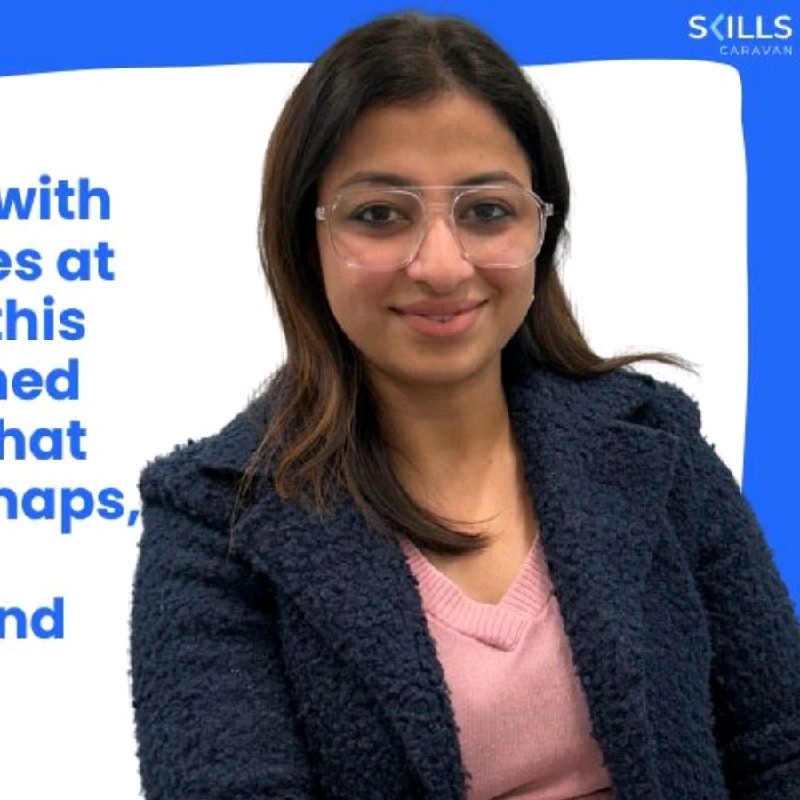

Shreya Verma is the VP of Product and Customer Success at Skills Caravan, where she leverages her decade-long expertise in learning & development (L&D) and human resources to shape an impactful, learner-centric platform. Her deep understanding of user needs, honed through hands-on L&D roles in leading companies, empowers her to translate insights into high-engagement interventions. At Skills Caravan, she bridges the gap between technology and people, ensuring learning experiences are not only effective but genuinely meaningful.




.png)
.png)
.png)
%20(1).png)
.png)


.webp)








Skillsoft is a global leader in corporate learning, providing digital training and education solutions to help businesses improve workforce productivity, reduce risk, and increase innovation.

FinShiksha provides a practical and industry-relevant approach to finance education, with courses designed by industry experts and delivered through interactive and engaging methods.

Wall Street Prep offers best-in-class financial training for aspiring finance professionals and corporate clients.

Udemy Business offers an unparalleled learning experience for organizations looking to upskill their workforce with over 155,000 courses taught by expert instructors.


.webp)


