


Skillsoft
Skillsoft is a global leader in corporate learning, providing digital training and education solutions to help businesses improve workforce productivity, reduce risk, and increase innovation.

![Employee Development Plan: Complete Guide with Free Templates [2026]](https://cdn.prod.website-files.com/641191414a39070a6c047208/69fc915f4147a3a2445b0b1f_Blog%20Banner.webp)
.webp)
Every HR leader knows the conversation. An ambitious team member sits across from their manager during the annual review, asking the obvious question: "What's my path forward here?" And the response—however well-intentioned—too often amounts to a vague nod toward courses they should consider, a mention of an internal opportunity that may or may not materialise, and a promise to "circle back next quarter." A well-designed employee development plan replaces that conversation with something measurable, accountable, and genuinely motivating. This guide is everything you need to build one in 2026—including downloadable templates, real examples, and the structured process that turns development from a checkbox into a competitive advantage. For organisations using a modern employee development and retention platform, the entire process becomes faster, more data-driven, and dramatically more effective.
This guide is written for HR leaders, People Operations teams, line managers, and individual contributors who want to move beyond the development plan as a once-a-year administrative artefact. We will cover what a strong development plan actually contains, the seven-step process to build one, free downloadable templates you can adapt to your organisation, real-world examples across five common roles, and the metrics that demonstrate the financial value of every plan you create.
The shift in 2026 is clear: organisations that treat development planning as a continuous, data-driven discipline outperform those that treat it as an annual ritual on every meaningful talent metric—retention, internal mobility, productivity, and employee engagement. By the end of this guide, you will have everything you need to be in the first group.
An employee development plan is a structured, time-bound roadmap that defines an employee's career goals, the specific capabilities they need to build, the learning activities required to develop those capabilities, and the milestones by which progress will be measured. It is the operational document that turns abstract aspirations into concrete progress.
What separates a strong plan from a weak one is specificity. "Improve communication skills" is not a development goal—it is a wish. "Lead three cross-functional project meetings in the next 90 days, complete the Advanced Stakeholder Management module on the company learning platform, and receive structured 360° feedback by the end of Q2" is a development goal. The first is forgettable. The second is actionable, measurable, and accountable.
Three structural shifts have made development planning a non-negotiable competency in 2026, not a nice-to-have:
1. Skills are obsoleting faster. The half-life of a technical skill has dropped to under three years for many functions. Without continuous, structured development, employees become less effective in their current roles within 18–24 months—and significantly less promotable within 36 months. Employee development plans are how organizations keep the workforce current at scale.
2. Retention has become a financial battleground. The average cost to replace an employee runs from 50% to 200% of their annual salary. LinkedIn's 2025 Workplace Learning Report found that employees who advance their skills internally are 75% more likely to stay three or more years. A modern learning experience platform that supports structured development planning is one of the most cost-effective retention investments any organization can make.
3. Employee expectations have shifted permanently. Gen Z and Millennials—now the majority of the workforce—evaluate employers heavily on growth opportunities, not just compensation. Organizations that cannot articulate a clear development path lose talent to competitors that can. Vague conversations no longer cut it.
"A development plan is a contract of intent between the organization and the employee. When you fail to deliver one, you are signalling that you do not see a future for that person here."
— Chief People Officer, Global Tech Company, 2025Gallup research shows that organizations with strong development planning practices report 59% lower voluntary turnover, 17% higher productivity, and 21% higher profitability than peers without these practices. The financial case is not subtle. Treat development planning as cost-cutting and retention combined—because empirically, that is what it is.
A development plan that omits any of these seven components will underperform—often dramatically. Each one serves a specific function, and they are designed to work together as an integrated system. Use this list as a quality checklist for any plan you create or review.
Where the employee stands today—their current role, demonstrated competencies, and verified skill levels. This is the baseline against which all progress will be measured. Without it, "improvement" is a feeling, not a fact. Modern skills benchmarking platforms generate this baseline automatically through structured assessments.
Example: Verified at "Proficient" in stakeholder management, "Developing" in data storytellingWhere the employee wants to go—both short-term (next role or expanded scope in current role) and longer-term (career trajectory). The aspirations must come from the employee, not be assigned by the manager. Without articulated direction, no plan can be meaningful.
Example: 12-month — Senior Analyst role | 3-year — Analytics team leadThe specific delta between current capabilities and what target roles or expanded scope require. This is the diagnostic that drives every development goal. A good gap analysis names skills precisely, indicates current and target proficiency levels, and prioritizes which gaps to close first.
Example: SQL — current Beginner, target Intermediate, priority HIGHSpecific, Measurable, Achievable, Relevant, Time-bound goals—typically 3–5 per planning cycle. More than five becomes unmanageable; fewer than three usually means the plan is not ambitious enough. Each goal should map directly to a skill gap identified in component three.
Example: Achieve Intermediate SQL proficiency by Q3 (verified by assessment)The exact actions the employee will take to achieve each goal. Mix formal learning (courses, certifications), social learning (mentorship, peer coaching), and experiential learning (stretch assignments, cross-functional projects). The 70-20-10 ratio—70% experience, 20% social, 10% formal—remains the gold standard for adult skill development.
Example: SQL Mastery Path on LXP + 2 cross-team data projects + monthly mentor sessionsDefined milestones at 30, 60, and 90 days where the employee and manager review progress, recalibrate goals, and remove blockers. Each goal should have explicit success criteria—how exactly will progress be measured? Without checkpoints, plans drift; without criteria, "completion" becomes subjective.
Example: Day 30 — Module 1 completed, Day 60 — first project shipped, Day 90 — proficiency assessedWhat the manager and organization will provide to make the plan executable—time allocation, project access, mentorship introductions, learning budget, sponsor visibility. A development plan that depends entirely on employee initiative without organizational support is a setup for failure dressed up as empowerment.
Example: Manager commits 1hr/week coaching, $1,500 learning budget, intro to mentorBuilding a strong development plan is not complicated, but it does require structure. This seven-step process can be completed in a single 60-minute conversation between an employee and their manager—provided the right preparation has been done. Use this as your repeatable build framework across every employee on every team.
Here is what a properly filled employee development plan template looks like for a real role. Use this as a model and adapt the structure to your organization's specific competency framework.
Organizations using a modern employee development and retention platform can auto-generate the skills assessment (step 1), recommend learning activities mapped to each goal (step 5), and surface checkpoint reminders (step 7) without manual intervention—reducing the time investment for managers from hours per plan to minutes.
Two frameworks separate development plans that produce real outcomes from those that produce documentation. The first—SMART—is widely known but inconsistently applied. The second—70-20-10—is widely cited but often ignored when activities are selected. Use both rigorously and your goal completion rate will improve significantly within a single planning cycle.
Names the exact skill, behaviour, or output. No vague verbs.
Has a defined success criterion that can be verified.
Stretches the employee but is realistic given resources.
Maps to a real career aspiration or business need.
Has a specific deadline, not "ongoing" or "this year."
| Dimension | ❌ Weak Goal | ✓ SMART Goal |
|---|---|---|
| Specific | "Improve presentation skills" | "Deliver 3 stakeholder-ready data insight presentations to leadership audiences" |
| Measurable | No metric | Manager rating ≥ 4/5 on each presentation |
| Achievable | Unclear | Realistic given training + 2 practice rounds |
| Relevant | Generic | Tied to Senior Analyst aspiration |
| Time-bound | "Throughout the year" | "By November 30, 2026" |
| Outcome | Forgotten in 3 weeks | Achieved and verifiable in performance review |
Decades of adult learning research—pioneered by the Center for Creative Leadership—show that the most durable skill development happens through experience, not formal training. The 70-20-10 framework expresses this empirically: 70% of skills are built through challenging on-the-job experience, 20% through social learning (mentorship, peer feedback, coaching), and 10% through formal courses. Plans that ignore this ratio—and load 80% of activities into formal training—consistently underperform.
| Activity Type | Examples | Best For |
|---|---|---|
| Experiential (70%) | Stretch projects, cross-functional rotations, leading new initiatives, customer-facing assignments, owning new metrics | Building applied capability under real conditions |
| Social (20%) | Mentorship, structured 1:1 coaching, peer learning circles, manager feedback sessions, shadowing | Pattern recognition, judgment development, network building |
| Formal (10%) | Online courses, certifications, workshops, conference sessions, structured learning paths on LXP | Foundational knowledge, frameworks, technical skills |
An organization that delivers world-class formal training but provides no stretch assignments will produce employees who know things but cannot do them. Effective employee development plan design requires intentional balance across all three categories—not heroic delivery in one. Modern corporate training programs work because they integrate formal content with social cohorts and real project work—exactly the 70-20-10 architecture in practice.
"You cannot lecture someone into capability. You can only create the conditions where they build it through doing—and then accelerate the process with the right coaching and the right knowledge inputs at the right moments."
— Talent Development Director, Global Bank, 2025One template does not fit every use case. The right format depends on the role level, the planning horizon, and the maturity of your organization's competency framework. Below are four template formats that cover the vast majority of scenarios—and the structural blueprint that any good employee development plan template should follow regardless of format.
The default template for most employees. Covers a 90-day planning horizon with 3–5 SMART goals, learning activities, and 30/60/90-day checkpoints. Best for general use across IC and management roles.
Specialized for the first 90 days of a new hire's tenure. Emphasizes onboarding milestones, role mastery, and integration goals rather than career-stretch development.
Long-horizon template for high-potential employees and leadership pipelines. Combines annual SMART goals with 3-year career trajectory mapping and succession-readiness assessment.
For employees moving into a new role—whether through promotion, lateral move, or internal transfer. Focuses heavily on capability gaps for the new role rather than current-role optimization.
The strongest employee development plan template is one that is consistent across the organization but flexible within each section. Lock the structure so plans can be compared and aggregated for HR analytics—but leave the content editable so plans reflect each employee's unique aspirations and gaps. Modern learning platforms include digital templates that auto-populate sections 4 and 5 from skills assessments, saving HR teams hours per employee.
Templates are universal; content is not. The most useful employee development plan examples are role-specific because the skill gaps, learning activities, and stretch assignments that matter for a sales executive look almost nothing like those that matter for a software engineer. Below are five filled-in examples drawn from common roles, each demonstrating how the template structure adapts while staying recognisably consistent.
A development plan that cannot demonstrate measurable outcomes is indistinguishable from a development plan that did not work. The most overlooked phase of the planning lifecycle is post-plan measurement—and it is the phase that most directly determines whether HR leaders can credibly defend their development investment to executive stakeholders. Build measurement into the plan from day one.
| Dimension | What It Measures | How to Quantify |
|---|---|---|
| Goal Completion | What % of stated goals were achieved on time | (Goals achieved ÷ Total goals) × 100 — target: 75%+ |
| Skill Proficiency Lift | Pre/post change in verified competency levels | Δ in skill assessment scores from baseline to plan close |
| Performance Impact | Change in role KPIs attributable to the plan | Compare key role metrics 6 months before vs. after plan |
| Career Outcomes | Promotions, scope expansion, lateral moves enabled | Track at 6, 12, and 18 months post-plan close |
Beyond individual plans, HR leaders should track aggregate metrics across the development planning program to identify trends and demonstrate program-wide ROI:
| Metric | Healthy Range | Why It Matters |
|---|---|---|
| % Employees with Active Plans | 85%+ | Coverage signals organizational commitment |
| Plan Quarterly Review Rate | 80%+ | Plans reviewed quarterly produce 3× outcomes vs. annual |
| Average Goal Completion Rate | 70%+ | Below 50% indicates unrealistic goals or weak support |
| Internal Mobility Rate | 25%+ | Plans should produce visible career movement |
| Voluntary Attrition (Plan vs. No Plan) | −40% lower | Direct retention signal from the program |
If the plan is written to satisfy HR rather than to drive growth, employees feel it. Plans created as compliance documents produce compliance-level outcomes — minimal.
"Improve communication" is not a goal. Without specificity and measurability, plans become aspirational mood boards, not accountable roadmaps.
Plans that depend entirely on employee initiative without explicit manager coaching time and resource access systematically underperform regardless of employee motivation.
Plans that consist entirely of "complete these courses" violate the 70-20-10 framework and produce knowledge without applied capability. Always include experiential and social learning.
Plans without scheduled 30/60/90-day reviews drift quickly and are forgotten. Reviews must be on calendars before the planning conversation ends.
Treating a development plan as a thinly disguised performance improvement plan destroys psychological safety. The two are different documents with different purposes — keep them separate.
If the manager dictates the employee's career goals, the plan is doomed. Aspirations must come from the employee. The manager's job is to help build the path, not choose the destination.
Plans that aren't measured at close cannot demonstrate ROI, cannot inform next-cycle improvements, and signal to employees that outcomes don't matter. Always close with reflection and outcome capture.
Visit the Skills Caravan blog for additional guides on skills benchmarking, leadership development frameworks, and L&D measurement strategies that connect development planning to measurable business outcomes.
The organizations winning the 2026 talent war are not the ones with the highest learning budgets or the flashiest internal academies. They are the ones who have made development planning a continuous, structured, measurable discipline embedded in every manager's workflow. The financial return on this investment is documented, repeatable, and accessible to any organization willing to commit to the practice.
What separates strong development plans from weak ones is not complexity—it is rigor. Specific goals beat vague intentions. Verified skill assessments beat self-reported impressions. 30/60/90-day checkpoints beat annual reviews. Manager commitments beat employee-only ownership. Aggregate measurement beats isolated reflection. And modern employee development plans built on a connected skills platform beat scattered Word documents shared via email every single time.
The seven-step process, the universal template structure, the SMART goal framework, the 70-20-10 activity ratio, the four dimensions of plan measurement, and the eight mistakes to avoid—everything in this guide is operational, not theoretical. Start with one team this quarter. Build a single high-quality plan for each employee. Review it in 30 days. Iterate. Within two quarters, you will have empirical proof that the practice works in your organization. Within a year, you will be in a different conversation with finance about the value L&D delivers to the business.
If you are ready to operationalize development planning at scale—with structured templates, AI-powered skills assessments, and real-time progress tracking—explore how Skills Caravan's employee development and retention platform turns the principles in this guide into a continuous, measurable practice across your entire workforce.
Everything HR leaders, managers, and individual contributors need to know about building development plans that produce real outcomes in 2026.
An employee development plan is a structured roadmap that outlines an employee's career goals, the skills they need to acquire, the learning activities required to build those skills, and the timeline for measurable progress. It is created jointly by the employee and their manager, aligned to both individual aspirations and organizational priorities. A well-designed plan turns vague growth conversations into a concrete, accountable, and reviewable framework that drives both performance and retention.
Creating an effective plan in 2026 follows seven steps: (1) assess current skills through structured benchmarking, (2) clarify career aspirations and 12-month goals, (3) identify specific skill gaps between current and target state, (4) define SMART learning objectives, (5) select learning activities mapped to each objective, (6) set review checkpoints at 30, 60, and 90 days, and (7) document outcomes for performance reviews and succession planning.
A complete template should include: employee profile and current role, career aspirations (12-month and 3-year), current skills assessment, identified skill gaps, 3–5 SMART development goals, specific learning activities for each goal, target completion dates, success measurement criteria, manager support commitments, review checkpoints, and a section for outcomes and reflection. The best templates also include space for stretch assignments, mentorship arrangements, and cross-functional projects.
A development plan is forward-looking and growth-oriented—it builds new capabilities for current and future roles. A performance improvement plan (PIP) is corrective and remedial—it addresses specific performance deficiencies that need to be resolved within a defined timeline. Conflating the two transforms development conversations into something employees experience as threatening rather than supportive.
Plans are most effective when ownership is explicitly shared. The employee owns their career aspirations, learning commitments, and self-directed skill building. The manager owns the role context, organizational opportunities, performance feedback, and resource access required to make the plan executable. HR provides the framework, tools, and platforms that make planning consistent across the organization.
Best practice is a quarterly cadence: a 30-day initial check-in, 60-day milestone review, 90-day comprehensive review, and an annual review aligned to the performance cycle. Plans that are reviewed only annually rapidly become outdated artefacts. Plans reviewed quarterly become living tools that drive continuous progress and stay aligned to a fast-changing business environment.
Effective plans look very different across roles. A sales account executive might focus on enterprise selling skills and mastery of negotiation. A software engineer might prioritize depth in system design and technical leadership. An HR business partner might develop data analytics and organizational design. A first-time manager might build coaching skills and team-level prioritization. Strong examples specify learning activities tied to each capability and measurable success criteria for each goal.
Plan success is measured across four dimensions: (1) goal completion rate—what percentage of defined development goals were achieved within the planned timeframe, (2) skill proficiency improvement—measurable change in competency assessments, (3) performance impact—improvement in role-specific KPIs attributable to the development activities, and (4) career outcomes—internal promotion, role expansion, or successful lateral moves enabled by the new capabilities.
Skills Caravan delivers AI-powered skill assessments, structured plan templates, and continuous progress tracking — turning every development plan into a measurable retention investment.
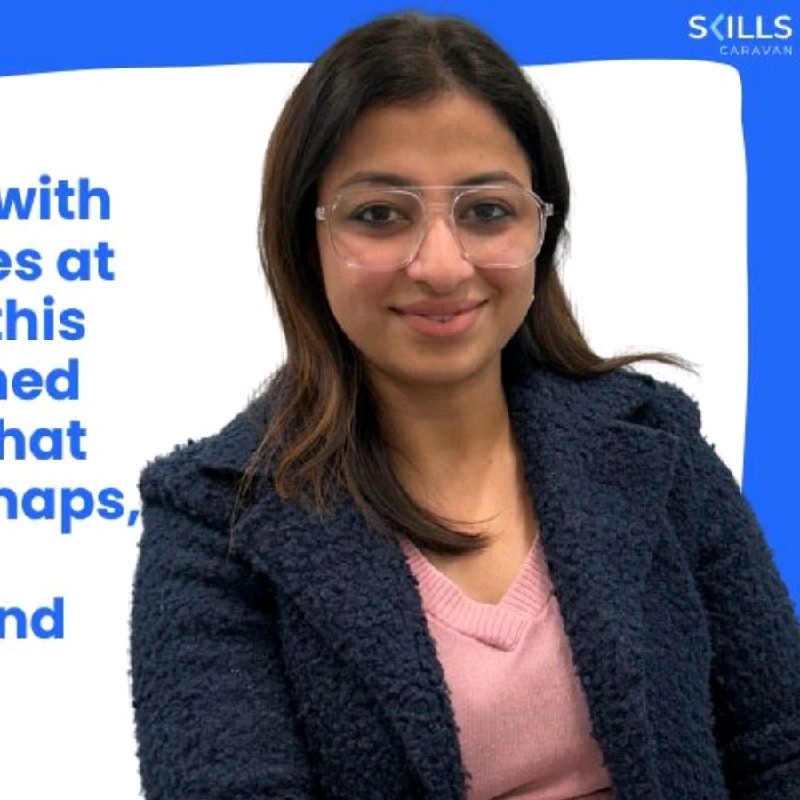

Shreya Verma is the VP of Product and Customer Success at Skills Caravan, where she leverages her decade-long expertise in learning & development (L&D) and human resources to shape an impactful, learner-centric platform. Her deep understanding of user needs, honed through hands-on L&D roles in leading companies, empowers her to translate insights into high-engagement interventions. At Skills Caravan, she bridges the gap between technology and people, ensuring learning experiences are not only effective but genuinely meaningful.
See how enterprises close skill gaps with AI. We'll email your brochure instantly.
Please enter your name, a valid email, and your phone number.
We respect your privacy. No spam — unsubscribe anytime.
Your platform overview is on its way. You can also download it right now.
Download Brochure


.png)
.png)
.png)
%20(1).png)
.png)


.webp)




Skillsoft is a global leader in corporate learning, providing digital training and education solutions to help businesses improve workforce productivity, reduce risk, and increase innovation.

FinShiksha provides a practical and industry-relevant approach to finance education, with courses designed by industry experts and delivered through interactive and engaging methods.

Wall Street Prep offers best-in-class financial training for aspiring finance professionals and corporate clients.

Udemy Business offers an unparalleled learning experience for organizations looking to upskill their workforce with over 155,000 courses taught by expert instructors.


.webp)

