


Skillsoft
Skillsoft is a global leader in corporate learning, providing digital training and education solutions to help businesses improve workforce productivity, reduce risk, and increase innovation.

.jpg)
.webp)
Every organisation trains its people, whether it plans to or not — the only question is whether that learning is deliberate or accidental. When it is deliberate, it has a name in human resource management: training and development. It is the function that turns a workforce from a fixed set of skills into a capability that grows with the business, and it is one of the clearest ways HR contributes directly to performance and retention.
This guide explains training and development in HRM from the ground up: what it means, how training differs from development, why it matters, the step-by-step process, the main types and methods, how to measure it, and the role technology now plays. It is written to be genuinely useful whether you are studying HR or building a real programme.
It is the HR function that improves employees' knowledge, skills, and abilities — so they perform better now and grow for the future.
Training builds the specific skills needed for the current role; development grows broader capability for future roles and career progression. Same function, two time horizons.
The sections below work through the distinction, the objectives, the process, the methods, and measurement. For a practical companion on planning growth for an individual, see our guide to employee development plans.
The two words are often used together and sometimes treated as the same thing, but the distinction matters — it changes what you deliver, to whom, and how you measure it. The simplest way to hold it: training is about the job; development is about the person.
| Dimension | Training | Development |
|---|---|---|
| Time horizon | Short-term | Long-term |
| Focus | Specific skills for the current role | Broad capability for future roles |
| Goal | Do the current job well | Grow for what comes next |
| Scope | Narrow, task-based | Wide, career-based |
| Driven by | Role and skill gaps | Potential and aspiration |
| Typical outcome | A measurable skill or certification | Readiness for a bigger role |
Neither replaces the other. A new hire needs training to become productive; a high performer needs development to stay and grow. The strongest HR functions run both deliberately — training to close today's gaps, development to build tomorrow's leaders — as two halves of one system. The next question is why that system is worth the investment.
Training and development is not a perk or a compliance chore — it is one of the few HR levers that moves performance, retention, and capability at the same time. These are the objectives it serves and the benefits it returns.
People who know how to do their jobs well make fewer errors and work faster — the most direct return.
Targets the difference between the skills a workforce has and the ones the strategy needs.
A visible path to grow is one of the strongest reasons people stay rather than leave.
Grows skills and future leaders from within, reducing reliance on expensive external hiring.
A workforce that keeps learning adjusts faster to new technology, markets, and ways of working.
Ensures mandatory and safety training is delivered, evidenced, and current across the organisation.
Organisations known for developing people attract better talent and stronger applications.
Read together, these turn people from a fixed cost into a growing asset. But the benefits only appear when training is run as a deliberate process — which is the next section.
Effective training and development in HRM follows a five-step cycle, not a one-off event. Each step feeds the next, and evaluation loops back to the start — which is what makes the programme improve over time rather than repeat the same courses.
Run a training needs analysis to find the gap between current skills and what the role and strategy require.
Define clear, measurable learning objectives — what people should know or be able to do afterwards.
Choose content, methods, and delivery — on-the-job, off-the-job, or blended — matched to the objectives and audience.
Run the programme, increasingly through a learning platform so it is consistent, tracked, and available in the flow of work.
Measure results against the objectives, then feed what you learn back into the next needs analysis.
The loop is the point: evaluation is not the end but the input to the next cycle. Skip the needs analysis at the start, or the evaluation at the end, and training becomes activity without direction. For the first step specifically, see our guide to conducting a training needs assessment.
Methods fall into three broad groups. Training methods split into on-the-job and off-the-job; development leans on a third set focused on growing the person. Most organisations blend across all three rather than relying on one.
The 70-20-10 idea runs through the best programmes: most growth comes from real work and other people, with formal courses the smallest slice. Increasingly, all three are delivered and tracked through a learning platform, which is where measurement — the next section — becomes possible.
Measurement is where training and development in HRM proves its worth — and where many programmes are weakest. A widely used model evaluates four levels, each a step closer to real business impact.
Did learners find the training relevant and engaging? Useful, but the weakest signal on its own.
Did they actually gain the knowledge or skill? Measured through assessment, not attendance.
Did their behaviour change on the job? The point where training starts to matter in practice.
Did business outcomes improve — performance, productivity, quality, retention? The level leadership cares about.
Modern practice adds a fifth lens: measure skills built, not courses completed, so evaluation tracks the capability an organisation is actually gaining. Whichever model you use, the rule is the same — define success measures before the training starts, so you judge it against clear objectives rather than a completion percentage. That is far easier when learning runs on a platform that tracks it, which the next sections cover.
Even well-funded programmes stumble on the same issues. Each has a practical fix.
Training with no link to a real business need.
Start every programme with a needs analysis, so learning targets an actual gap, not a guess.
One-off events with no follow-up or reinforcement.
Treat it as a continuous cycle — reinforce in the flow of work, not a single session that fades.
Measuring attendance instead of impact.
Set success measures up front and evaluate behaviour and results, not just completions.
Generic content that ignores role and level.
Personalise pathways by role and skill gap so learning is relevant to each person.
Low engagement and completion.
Use microlearning, mobile access, and relevant content so learning fits how people actually work.
Notice how many fixes point the same way — toward relevance, continuity, and measurement. That is exactly what technology now makes practical at scale, which is the next section.
For most of its history, training and development was limited by logistics — you could only train as many people, as often, as classrooms and trainers allowed. Technology removed that ceiling. A learning management system or learning experience platform delivers learning to a distributed workforce, personalises it by role, tracks progress and skills, automates compliance and certification, and gives HR a live view of capability across the organisation.
Choosing the right platform is its own decision — an LMS enforces and evidences, an LXP engages and personalises, and skills platforms measure capability. Most organisations now want all three in one system. For how those categories differ and which fits, see our guide to LMS vs LXP vs skills platforms, and our primer on what an LMS is.
Skills Caravan supports the complete cycle of training and development in HRM — from finding the gap to proving the result — in a single platform that combines an LMS, an LXP experience, and skills analytics.
Skill-gap analysis maps what the workforce has against what roles and strategy need, so training starts from data.
Role-based, personalised learning paths for both short-term training and longer-term development.
Mobile, microlearning-friendly delivery in the flow of work, with compliance and certification built in.
Track skills built and outcomes, not just completions, with reporting leadership can act on.
Feed results back into the next cycle, so the programme gets sharper each round.
The result is training and development run as a measurable capability rather than an administrative task. For how this connects to keeping people, see our guide to employee development and retention.
Skill-gap analysis, personalised learning, compliance, and skills reporting in one platform — the full cycle, measured. See Skills Caravan on a live demo.
Book a demo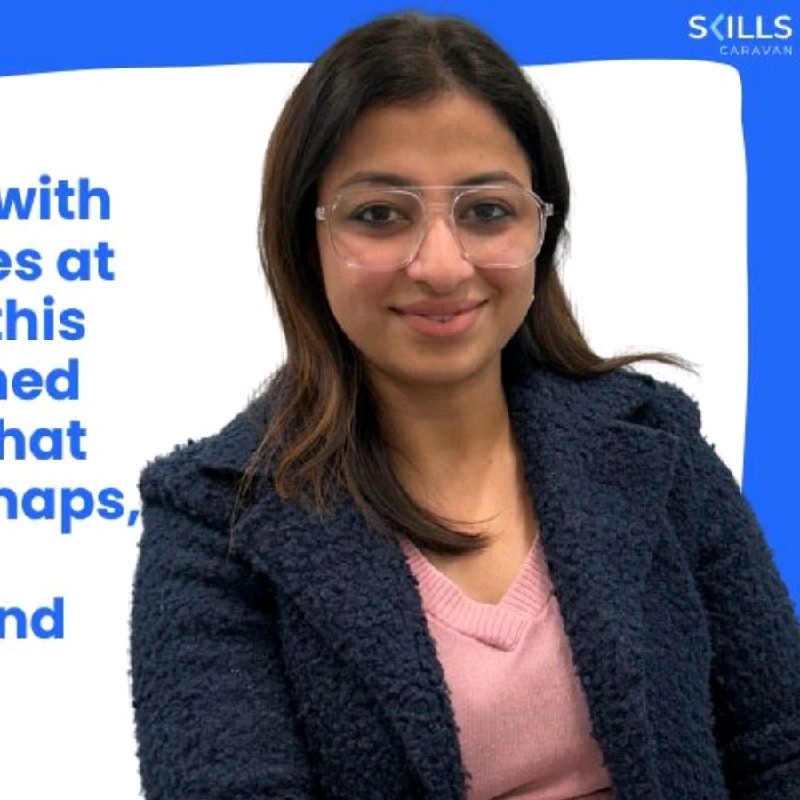

Shreya Verma is the VP of Product and Customer Success at Skills Caravan, where she leverages her decade-long expertise in learning & development (L&D) and human resources to shape an impactful, learner-centric platform. Her deep understanding of user needs, honed through hands-on L&D roles in leading companies, empowers her to translate insights into high-engagement interventions. At Skills Caravan, she bridges the gap between technology and people, ensuring learning experiences are not only effective but genuinely meaningful.


.png)
.png)
.png)
%20(1).png)
.png)


.webp)




Skillsoft is a global leader in corporate learning, providing digital training and education solutions to help businesses improve workforce productivity, reduce risk, and increase innovation.

FinShiksha provides a practical and industry-relevant approach to finance education, with courses designed by industry experts and delivered through interactive and engaging methods.

Wall Street Prep offers best-in-class financial training for aspiring finance professionals and corporate clients.

Udemy Business offers an unparalleled learning experience for organizations looking to upskill their workforce with over 155,000 courses taught by expert instructors.


.webp)


