

Skillsoft
Skillsoft is a global leader in corporate learning, providing digital training and education solutions to help businesses improve workforce productivity, reduce risk, and increase innovation.


.webp)
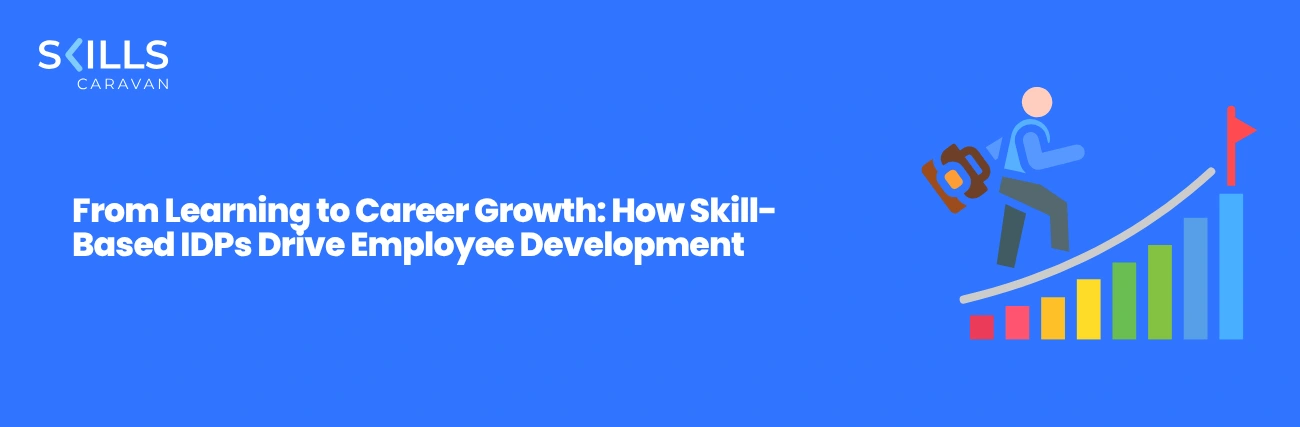
Old-school employee development just doesn't cut it anymore. Those one-size-fits-all training sessions and generic courses? They don’t move the needle. Now, companies are leaning into skill-based, AI-driven Individual Development Plans (IDPs). These aren’t just buzzwords—they actually tailor learning to each person, using real data to connect what you learn with how you perform, how fast you grow, and how flexible your team stays. When you pull together career pathing, talent mobility, and AI that really understands your team's skills, you stop just “training” people. Instead, you actually help them grow, while the whole organization gets stronger.
A skill-based AI-driven IDP is a personalized development plan that:
Powered by AI and skills data, these IDPs are dynamic and continuously evolving, unlike traditional ones.
Many organizations still rely on outdated development models.
All this leads to low engagement. Employees aren’t interested, and the business isn’t really getting any stronger.
Skill-based IDPs shift the focus from training completion to capability building.
AI looks at your role, your skills, and your goals. Then it recommends learning that you’ll actually use.
Companies can see where skills are missing and fix the problem fast.
Development isn’t just for fun—it’s tied to what the company wants to achieve.
HR and managers can see what the workforce is capable of and who’s ready for new challenges.
Career pathing is a giant part of this. It shows employees exactly where they can go, what skills they need for the next step, and why growing matters. When people see a clear path, they work harder to get there.
It provides employees with:
When employees understand where they are going, they are more engaged in how they grow.
Talent mobility enables organizations to:
Skill-based IDPs make internal mobility possible by
Personalized learning increases participation and motivation.
Targeted learning accelerates capability building.
Employees stay longer when they see career growth opportunities.
HR teams can align skills with future business needs.
Define key skills across roles and departments.
Use platforms to map employee capabilities.
Adopt systems that recommend personalized learning journeys.
Align skills with future roles.
Continuously track progress and refine strategies.
The future of work is skills-driven, AI-powered, and employee-centric.
Organizations investing in:
will build resilient, future-ready workforces.
Skill-based IDPs are transforming how organizations approach employee development. By combining AI, skills intelligence, career pathing, and talent mobility, companies can create personalized growth journeys that benefit both employees and the business. As organizations move toward a skills-first future, adopting AI-driven IDPs is no longer optional—it is essential.


Zainab is an experienced LearnTech leader with a strong track record of building and scaling digital learning solutions across the Middle East, Africa, APAC, the UK, and the USA. With deep expertise in Generative AI, capability development, and data-driven learning strategies, she has helped organizations modernize their learning ecosystems, enhance employee readiness, and deliver impactful, scalable L&D outcomes. Her work blends innovation with strategic clarity, enabling enterprises to adopt future-ready learning models that drive sustainable growth.
See how enterprises close skill gaps with AI. We'll email your brochure instantly.
Please enter your name, a valid email, and your phone number.
We respect your privacy. No spam — unsubscribe anytime.
Your platform overview is on its way. You can also download it right now.
Download Brochure



.png)
.png)
.png)
%20(1).png)
.png)


.webp)







Skillsoft is a global leader in corporate learning, providing digital training and education solutions to help businesses improve workforce productivity, reduce risk, and increase innovation.

FinShiksha provides a practical and industry-relevant approach to finance education, with courses designed by industry experts and delivered through interactive and engaging methods.

Wall Street Prep offers best-in-class financial training for aspiring finance professionals and corporate clients.

Udemy Business offers an unparalleled learning experience for organizations looking to upskill their workforce with over 155,000 courses taught by expert instructors.


.webp)

