


Skillsoft
Skillsoft is a global leader in corporate learning, providing digital training and education solutions to help businesses improve workforce productivity, reduce risk, and increase innovation.

.webp)
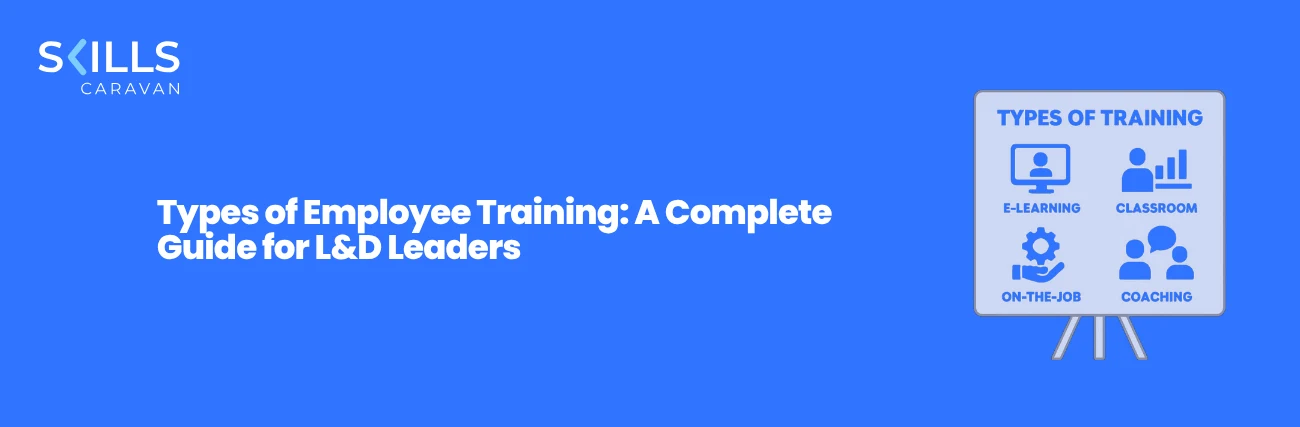
L&D leaders in 2026 are not short on options. The challenge is no longer finding training content — it is choosing the right types of employee training for the specific outcomes the business needs to produce. Compliance training cannot replace leadership development. Soft skills training will not close a technical capability gap. Onboarding programs and reskilling initiatives serve completely different audiences with completely different success criteria. This guide breaks down the 10 essential training categories every L&D leader should understand, when to use each one, and how to combine them into a training portfolio that delivers measurable workforce outcomes.
This article is written for CHROs, L&D directors, HR business partners, and training managers building or refining their organization's employee training programs. It assumes you already know training matters — your CFO knows that, your CHRO knows that, your board knows that. What this guide gives you is the decision framework to allocate training investment across categories rather than spreading it thin across every training type your platform vendor sells.
Employee training programs are structured learning initiatives designed to build specific workforce capabilities — including job-specific skills, role onboarding, regulatory compliance, leadership behaviors, and emerging competencies like AI literacy. Modern training programs are typically delivered through Learning Experience Platforms (LXPs) or Learning Management Systems (LMS), combine multiple formats (e-learning, microlearning, instructor-led, on-the-job), and are measured by business outcomes such as retention rate, productivity gain, time-to-competency, and skills gap closure rather than completion rate alone.
The most common mistake in L&D budget allocation is treating training as one undifferentiated activity. Organizations spend heavily on content libraries, hope that broad exposure produces results, and then struggle to explain to finance leadership why retention, productivity, and skill gap metrics have not moved. The reason is structural: different business outcomes require different training types, and a generic content catalog does not produce specific outcomes.
A retention problem driven by management quality is not solved by adding more compliance modules. A productivity gap in your engineering team is not closed by sending everyone through leadership development. A new-hire attrition issue is not fixed by a one-day orientation session. Choosing the right training type for the right problem is the single most important decision an L&D leader makes — more important than platform selection, content sourcing, or delivery format. This is why organizations that connect L&D directly to employee retention outcomes consistently outperform peers that treat training as a generic spend category.
| Business Outcome | Primary Training Type | Supporting Training Type |
|---|---|---|
| New hire retention (first year) | Onboarding & orientation | Manager development |
| Voluntary attrition reduction | Leadership development | Career-pathing & upskilling |
| Productivity improvement | Technical skills training | Soft skills & process training |
| Compliance risk reduction | Compliance & regulatory training | Annual refresher cycles |
| Sales performance | Sales enablement training | Product knowledge training |
| Customer experience improvement | Customer service training | Product training |
| Future-proofing workforce | Upskilling & reskilling | AI literacy training |
| Internal mobility expansion | Cross-functional skills training | Skills benchmarking |
HBR research found that only 12% of employees apply what they learn in formal training back on the job. The 88% that does not get applied is rarely because the content was bad — it is because the training type was misaligned with the actual capability gap, or the post-training reinforcement was missing. Choosing the right training type is the first and most important step. The rest of this guide breaks down those 10 essential categories.
Onboarding training is the structured learning program that integrates new hires into a role, team, and organization over their first 30 to 180 days of employment. It is one of the highest-leverage L&D investments any organization makes — because 76% of voluntary exits occur in the first year of employment, and the quality of onboarding is the single strongest predictor of first-year retention.
The distinction between onboarding and orientation matters. Orientation is a short, event-based introduction — usually delivered in the first 1–3 days, covering paperwork, policy briefings, IT setup, and culture overview. Onboarding is the longer structured program that builds role-specific competence, social integration, and career path clarity over weeks or months. Treating orientation as the complete onboarding experience is one of the most expensive mistakes organizations make: it produces the documentation that compliance requires but not the engagement and competence that retention requires.
New hires in their first 30–180 days; internal transfers moving to substantially different roles; rehires returning after a year or more away.
First-year retention, time-to-full-productivity, employee engagement scores at 90 days and 6 months, manager effectiveness for new-team-member ramp.
30-day intensive phase, then ongoing through day 180. Most effective programs include structured manager 1:1 cadence throughout the period.
Mix of self-paced e-learning, live virtual sessions, on-the-job coaching, peer mentoring, and manager check-ins — not a single delivery channel.
For a deeper implementation framework — including the three-phase onboarding model that produces 82% higher 12-month retention — see Skills Caravan's employee onboarding solutions, which include onboarding learning paths, manager enablement tools, and retention impact tracking out of the box.
"Orientation is when you complete the paperwork. Onboarding is when you decide whether the person you hired will still be with you in 12 months."
— Skills Caravan Onboarding Framework, 2026Compliance training is mandatory workforce education on the laws, regulations, and internal policies that govern how employees must conduct their work. Unlike other training types, compliance training is rarely optional — it is required by legislation, industry regulators, or organizational policy, with documented completion serving as evidence of regulatory adherence. For regulated industries (financial services, healthcare, pharmaceuticals, manufacturing, government), it is the single most operationally critical training category an organization runs.
The challenge with compliance training is that it is universally disliked by employees and expensive to deliver well. Generic, click-through compliance modules produce documentation but rarely produce behavior change — meaning the underlying risk the training was supposed to mitigate remains. Modern compliance training programs solve this with scenario-based learning, role-specific modules, and automated tracking that proves both completion and comprehension to auditors.
All employees (for general compliance like anti-harassment); role-specific subsets for regulatory training (e.g., financial advisors for FINRA, healthcare staff for HIPAA, manufacturing workers for OSHA).
Regulatory penalty avoidance, audit readiness, reputational risk reduction, documented evidence of organizational compliance posture.
Annual cycle for most categories; quarterly refreshers for high-risk topics; immediate training when regulations change or incidents occur.
E-learning with knowledge checks, scenario-based simulations, automated certification tracking, audit-ready completion reporting.
Physical safety protocols, hazard recognition, emergency response, equipment handling — critical in manufacturing, construction, healthcare, and field service industries.
Anti-discrimination policy education, bystander intervention training, inclusive workplace behaviors — often legally mandated and increasingly scrutinized by regulators.
GDPR, CCPA, HIPAA, India's DPDP Act compliance; phishing recognition; data handling protocols. The fastest-growing compliance category in 2026.
Mandatory for global organizations and any organization in regulated commerce — covers gift policies, conflict of interest disclosure, and third-party due diligence.
Sarbanes-Oxley financial controls, anti-money laundering, know-your-customer protocols — mandatory in financial services and increasingly in fintech.
HIPAA (healthcare), FDA (pharma), FINRA (financial services), PCI-DSS (payments) — role-specific certifications required by industry regulators.
For organizations looking to consolidate compliance delivery, tracking, and certification management into a single auditable system, explore Skills Caravan's compliance training software — built specifically for regulated industries with full audit-trail reporting and automated certification renewal workflows.
The cost of compliance training is small compared to the cost of regulatory non-compliance. A single GDPR violation can result in fines of up to 4% of global annual revenue. A single OSHA citation averages $15,000 — with willful violations reaching $156,259 per instance. Compliance training is not a cost center — it is risk mitigation insurance with a documentable ROI based on the regulatory exposure being managed.
Technical skills training builds the role-specific hard skills employees need to perform their job — coding languages for developers, financial modeling for analysts, design tools for marketers, equipment operation for technicians, data platforms for analysts. It is the most direct training type in terms of measurable output: did the training improve the specific technical capability the role requires? If yes, productivity follows. If no, the training failed.
In 2026, technical skills training has become more critical and more challenging simultaneously. The half-life of technical skills continues to compress — the World Economic Forum projects 39% of core skills will be outdated by 2030 — meaning organizations need continuous technical upskilling rather than one-time training. This is where the connection between technical training and broader workforce strategy becomes important: for a deeper financial framework on how skills development translates to hiring savings and retention, see our analysis of skills-first talent strategy ROI.
Role-specific cohorts — engineers, analysts, designers, technicians, specialists. Increasingly delivered in personalized paths rather than uniform cohorts.
Direct productivity improvement, role-specific quality metrics, faster time-to-competency, reduced dependence on external contractors.
Varies — from 1-day intensive workshops to multi-month certification programs. Most effective when continuous rather than episodic.
Hands-on labs, simulation environments, certifications, peer code/work review, microlearning embedded in tools.
Soft skills training builds the interpersonal, communication, and behavioral capabilities that determine how effectively employees collaborate, lead, sell, serve customers, and adapt to change. Soft skills are also called "power skills" or "durable skills" — and despite their non-technical nature, they consistently rank among the most predictive capabilities for both individual career progression and team performance.
The misconception that soft skills cannot be trained — that they are innate personality traits — has been thoroughly disproven by 15+ years of behavioral research. Communication, empathy, conflict resolution, critical thinking, and adaptability are all learnable behaviors. They require different training approaches than technical skills — more scenario-based, more practice-driven, more reinforcement-dependent — but the outcomes are measurable when programs are designed correctly.
All employees — but particularly customer-facing roles, leadership pipeline, cross-functional collaborators, and high-performing technical individuals moving toward management.
Improved collaboration, reduced workplace conflict, better customer satisfaction scores, lower attrition driven by manager quality, stronger leadership pipeline.
Programs typically run 3–12 months, combining short instructional modules with extended practice and reinforcement over time.
Role-play exercises, scenario-based simulations, peer coaching, video case studies, manager-led practice sessions.
"Technical skills get you hired. Soft skills get you promoted, retained, and trusted with bigger work. Organizations that invest only in technical training build capable individuals who plateau at mid-career."
— Skills Caravan L&D Practice FrameworkLeadership development is the highest-leverage L&D investment available to most organizations — and yet it remains the most frequently underfunded. The reason it is high-leverage is straightforward: 71% of voluntary employee exits trace to poor management quality (Gallup), which means every dollar invested in making managers more effective compounds across every team member they supervise. Improve one manager's skills, and you improve retention, productivity, and engagement for 5–10 employees simultaneously.
Effective leadership development is not a single training program — it is a structured progression spanning multiple career stages. Aspiring leaders need different content than first-time managers. First-time managers need different content than senior leaders. Senior leaders need different content than executives. Organizations that run a single "leadership training" course for everyone produce limited results because the program cannot be deep enough for any specific level.
High-potential individual contributors, first-time managers, mid-level leaders, senior executives — each requiring distinct curriculum.
Team retention improvement, succession planning depth, manager effectiveness scores, internal promotion rates, engagement scores.
6–18 month structured programs, often delivered in cohorts with mentoring, coaching, and stretch assignments alongside instruction.
Cohort programs, executive coaching, 360-feedback assessments, action learning projects, mentor pairings, in-person and virtual blend.
HR.com's State of Employee Retention research found that retention leaders are nearly four times more likely to have well-trained people managers than retention laggards (37% vs. 10%). If your retention numbers are below industry benchmark, manager development is statistically the highest-probability intervention to improve them.
Product training is often categorized with sales enablement, but it deserves recognition as a distinct training type because its audience extends far beyond sales. Customer service teams need deep product knowledge to resolve issues effectively. Marketing teams need product fluency to communicate value propositions accurately. Support engineers need technical product knowledge. Partner enablement teams need product training for external channels. Even internal teams — finance, legal, operations — benefit from baseline product literacy.
Product knowledge training is also one of the most frequently updated training categories. Every product release, feature update, pricing change, or competitive positioning shift requires training refresh. Organizations that treat product training as a one-time event delivered at hire create knowledge debt that compounds rapidly — sales teams pitching outdated features, support agents troubleshooting deprecated workflows, marketing teams referencing obsolete capabilities.
Sales teams, customer success, support engineers, marketing, partner enablement, channel teams — anyone who represents the product externally or internally.
Sales effectiveness, support resolution rates, customer satisfaction, partner enablement success, marketing message accuracy.
Initial onboarding-phase deep dive (2–6 weeks); continuous updates with each product release; quarterly capability deep-dives.
Live product demos, hands-on product labs, certification exams, release notes microlearning, role-play scenarios.
Sales enablement training is a specialized category that combines product knowledge, sales methodology, soft skills, and competitive intelligence into a unified program for revenue-generating teams. It is distinct from generic sales training because it is anchored to a specific organization's products, sales process, and ideal customer profile — rather than teaching universal selling principles in the abstract.
Effective sales enablement is also one of the most directly measurable training types in any L&D portfolio. Sales metrics — win rate, deal size, sales cycle length, ramp time for new reps — respond visibly to training quality. This makes sales enablement one of the easiest training categories to demonstrate ROI for, but also one of the easiest to expose when it underperforms. Organizations that take sales enablement seriously typically deploy a dedicated sales enablement training platform integrated with their broader L&D infrastructure.
Account executives, sales development representatives, account managers, sales engineers, channel sales — including partner enablement.
Win rate improvement, deal size growth, shorter sales cycles, faster new-rep ramp time, higher quota attainment.
Onboarding bootcamp (4–8 weeks), then continuous monthly enablement aligned to product releases and quarterly strategy shifts.
Role-play simulations, recorded call reviews, pitch certifications, peer learning, deal coaching, live coaching from sales leadership.
Customer-facing training has two distinct sub-categories that L&D leaders should manage as related but separate programs. Customer service training develops the internal team that supports customers — service agents, account managers, technical support engineers. Customer training develops the external customers themselves, helping them become more successful with the product, which directly drives retention and expansion revenue.
Both categories are growing investment areas in 2026 as organizations recognize that customer experience is increasingly determined by post-sale interactions rather than pre-sale marketing. Strong customer service training reduces churn, increases customer lifetime value, and produces the referrals that lower acquisition costs. Strong customer training — delivered through a structured customer training platform — turns customers into power users who expand their usage and advocate for the product internally.
Internal: customer service teams, support engineers, account managers. External: customers, end users, channel partners, certified resellers.
Customer satisfaction (CSAT), Net Promoter Score (NPS), customer retention, expansion revenue, support ticket resolution rates.
Internal training is continuous (release-driven + customer trend-driven). External customer training is typically self-paced with certification milestones.
Internal: scenario simulations, call review coaching, knowledge base certification. External: self-paced courses, webinars, customer academy programs.
Upskilling and reskilling are often discussed together, but they address fundamentally different workforce challenges. Upskilling builds additional skills on top of an employee's current capability so they can perform their existing role at a higher level or take on adjacent responsibilities. Reskilling trains employees in substantially new capabilities so they can move into different roles — typically because their original role is being changed by automation, restructuring, or technology shifts.
Both have become strategic priorities in 2026. The World Economic Forum projects that 50% of all employees will require some form of reskilling by 2026, and 39% of core workforce skills will become outdated by 2030. Organizations that build systematic upskilling and reskilling programs can retain valuable employees through role transitions rather than hiring externally — generating significant cost savings while preserving institutional knowledge.
Existing employees facing skill obsolescence; employees in roles being automated; high-potential employees being prepared for adjacent roles; entire workforce segments during transformation initiatives.
Retention of valuable employees through role changes, reduced external hiring costs, faster organizational adaptation to technology shifts, internal mobility expansion.
Upskilling: continuous, in 3–6 month increments. Reskilling: structured 6–12 month programs with intensive learning + on-the-job application.
Cohort programs, personalized learning paths, mentor pairings, project-based application, certification milestones, manager check-ins.
Same role, higher capability. A marketing analyst learning advanced data analytics. A customer service agent earning a senior support certification. A developer learning a new programming framework. Goal: better performance in current role and readiness for promotion.
New role, new capability set. A retail employee training to become a digital customer experience specialist. A factory worker reskilling for robotics oversight. An admin reskilling into a data analyst role. Goal: career pivot enabled by structured learning rather than external hiring.
AI literacy training is the fastest-growing employee training category in 2026, and the one with the most uneven adoption across organizations. The need is universal — 4 in 5 employees say they want AI-related training, but most organizations are still figuring out what to teach, at what level, to which employees. The result is a market where some organizations are running mature AI literacy programs with belt-style certification tracks for different roles, while others are still distributing generic "intro to ChatGPT" decks.
The most effective AI training in 2026 follows a tiered approach. Foundation tier — universal AI literacy for all employees, covering basic AI concepts, responsible use, and prompt engineering fundamentals. Application tier — role-specific AI skill development for functions like HR, Finance, Marketing, Sales, and Engineering, focused on the AI tools and workflows specific to each function. Specialist tier — deeper technical training for employees building or implementing AI systems. This belt-style progression model has become the dominant framework for enterprise AI capability building.
Foundation tier: all employees. Application tier: function-specific cohorts (HR, Finance, Marketing, Sales). Specialist tier: technical and data teams building or deploying AI systems.
Workforce productivity gains from AI tool adoption, responsible AI use compliance, internal capability for AI implementation, reduced dependence on external AI consultants.
Foundation: 8–20 hours. Application: 40–60 hours per function. Specialist: 80–120 hours with hands-on projects. All delivered as ongoing programs rather than one-time courses.
Self-paced e-learning + live workshops + hands-on labs + certification + applied projects. Belt-style progression maintains engagement and provides visible milestones.
AI training is uniquely demanding to deliver — it requires hands-on labs, frequent content updates, role-specific personalization, and certification tracking. For organizations running AI training alongside the other 9 training categories in this guide, a modern enterprise LXP is the practical infrastructure. Trying to deliver AI training through a legacy LMS while running everything else through a separate platform produces exactly the fragmentation problem L&D leaders should be eliminating.
Knowing the 10 training types is the foundation. Building the right portfolio mix for your specific organization is the harder question. Most L&D leaders inherit a training budget that is allocated by historical precedent rather than strategic priority — compliance gets a fixed amount because it must, leadership development gets whatever is left, and emerging needs like AI literacy get squeezed in at the edges. A more disciplined approach is to allocate training investment by the financial impact of each training type's outcome.
| Training Type | Typical Allocation (% of L&D budget) | Primary Business Justification |
|---|---|---|
| Onboarding & Orientation | 15–20% | First-year retention impact ($1M+ savings at 500-person org) |
| Compliance & Regulatory | 15–25% | Mandatory; regulatory penalty avoidance |
| Leadership Development | 15–20% | 71% of voluntary exits trace to management quality |
| Technical Skills Training | 15–20% | Direct productivity and capability gain |
| AI Literacy & AI Skills | 10–15% | Workforce future-proofing; the fastest-growing category |
| Soft Skills Training | 5–10% | Collaboration, customer experience, manager pipeline |
| Sales Enablement | Function-specific budget | Direct revenue impact; measured by sales metrics |
| Customer Training | Function-specific budget | Retention, expansion, support cost reduction |
| Upskilling & Reskilling | 5–15% | Internal mobility, retention, transformation enablement |
| Product Training | Embedded in role-specific tracks | Sales effectiveness, support quality, marketing accuracy |
These ranges are starting points, not prescriptions. Your specific allocation should reflect your organization's industry, current attrition profile, regulatory exposure, and strategic priorities. A regulated financial services firm will spend more on compliance. A high-growth tech company will spend more on onboarding and AI literacy. A mature consumer goods organization will spend more on leadership development. The key principle is that allocation should follow strategic outcome priority, not historical precedent.
Each of the 10 training types covered in this guide solves a specific workforce capability problem. Onboarding solves new-hire integration. Compliance solves regulatory risk. Leadership development solves management quality. Technical training solves capability gaps. Soft skills training solves collaboration and communication. Sales enablement solves revenue effectiveness. Customer service training solves CX. Customer training solves adoption and retention. Upskilling and reskilling solve future-proofing. AI literacy solves the most consequential capability shift of this decade.
The organizations that get the most out of their L&D investment in 2026 are not the ones with the largest training budgets — they are the ones that match training type to business problem with the most precision. A clear-eyed L&D leader running a $500,000 training portfolio against well-defined outcome metrics will outperform a $5 million training budget allocated by tradition every time.
If you are building or rebuilding your organization's training portfolio across these 10 categories — and want a platform infrastructure capable of delivering all of them through a single integrated system — explore Skills Caravan's corporate training platform, designed to consolidate onboarding, compliance, leadership, technical, sales, customer, AI literacy, and upskilling delivery into one configurable enterprise system.
Direct answers to the most common questions L&D leaders, HR business partners, and CHROs ask about employee training types and program design in 2026.
The 10 main types of employee training are: onboarding and orientation training, compliance and regulatory training, technical skills training, soft skills training, leadership development, product knowledge training, sales enablement training, customer service training, upskilling and reskilling programs, and AI literacy training. Each addresses a distinct workforce capability need. Most modern organizations use a combination of these training types delivered through a single learning experience platform rather than separate systems for each category.
The most common employee training programs in 2026 are onboarding (run by virtually every organization), compliance training (mandatory in regulated industries), leadership development (top investment priority for 71% of L&D leaders per LinkedIn 2025 data), and AI literacy training (the fastest-growing category, with 4 in 5 employees wanting AI-related upskilling). Upskilling and reskilling programs are also accelerating, driven by World Economic Forum projections that 39% of core workforce skills will become outdated by 2030.
The most effective type of employee training depends on the business outcome being targeted. For retention, leadership development and career-pathing programs deliver the highest impact — addressing the 71% of voluntary exits driven by management quality. For productivity, technical skills training and AI literacy programs produce measurable output gains. For compliance risk reduction, structured regulatory training is the only effective option. Effectiveness is determined less by training type and more by personalization, role-relevance, manager involvement, and post-training reinforcement.
Choose the right employee training type through a four-step process: (1) identify the business outcome the training must produce — retention, productivity, compliance, or capability building; (2) assess current skills against role requirements using a skills benchmarking framework; (3) match the training type to the gap — onboarding for new hires, compliance for regulatory gaps, technical training for capability gaps, leadership development for management quality gaps; (4) prioritize based on financial impact, focusing on training types that address the largest cost or risk first.
Orientation training is a short event-based introduction to the company — typically delivered in the first 1–3 days — covering basic policies, paperwork, and culture. Onboarding training is a longer structured program — typically running 30 to 180 days — that builds role-specific competence, social integration, and career path clarity. Orientation is a subset of onboarding. Organizations that treat orientation as the complete onboarding experience consistently see higher first-year attrition, since structured onboarding correlates with 82% higher 12-month retention compared to administrative orientation alone.
Training program duration depends on the type: onboarding programs typically run 30 to 180 days; compliance training is usually delivered annually with quarterly refreshers; leadership development programs run 6 to 18 months with cohort-based structure; technical skills training varies from 1-day intensive courses to multi-month certifications; and microlearning sessions are intentionally short (3–10 minutes) and delivered continuously rather than in scheduled blocks. The most effective programs use a portfolio approach combining short microlearning embedded in workflow with longer-form structured programs.
Employee training programs deliver measurable ROI across four dimensions: retention improvement (companies with strong learning cultures retain 57% of employees vs. 27% for moderate cultures), productivity gains (24% higher profit margins in organizations investing more in quality training), internal mobility savings (averaging $38,000 per role filled internally vs. external hire), and compliance risk reduction. Targeted training investments typically deliver 4.2× ROI compared to reactive rehiring, making training one of the highest-leverage HR investments available.
Employee training programs in 2026 are changing in five key ways: (1) AI-powered personalization is replacing one-size-fits-all course catalogs; (2) microlearning embedded in workflow tools (Teams, Slack) is replacing scheduled training events; (3) skills-based approaches are replacing role-title-based training assignments; (4) AI literacy training is becoming a foundational category alongside compliance and onboarding; and (5) measurement is shifting from completion rates to business outcomes like retention, productivity, and internal mobility — driven by CFO requirements for L&D ROI evidence.
Skills Caravan brings onboarding, compliance, leadership, technical, sales, customer, AI literacy, and upskilling delivery into a single configurable learning experience platform — with built-in skills benchmarking and CFO-ready impact analytics.


Meet Sarita Chand, a visionary entrepreneur whose journey over the past 17+ years spans investment banking, ed-tech, and social impact. As the Co-Founder of EduPristine, she helped build the business from the ground up — raising funding from the likes of Accel Partners and Kaizen PE — and ultimately guiding its acquisition by Adtalem Global Education (ATGE, NYSE). Before founding her own ventures, she sharpened her financial acumen working at top-tier firms including Goldman Sachs and the Aditya Birla Group, gaining deep exposure to capital markets, risk management, and global strategy.


.png)
.png)
.png)
%20(1).png)
.png)


.webp)






Skillsoft is a global leader in corporate learning, providing digital training and education solutions to help businesses improve workforce productivity, reduce risk, and increase innovation.

FinShiksha provides a practical and industry-relevant approach to finance education, with courses designed by industry experts and delivered through interactive and engaging methods.

Wall Street Prep offers best-in-class financial training for aspiring finance professionals and corporate clients.

Udemy Business offers an unparalleled learning experience for organizations looking to upskill their workforce with over 155,000 courses taught by expert instructors.


.webp)


